

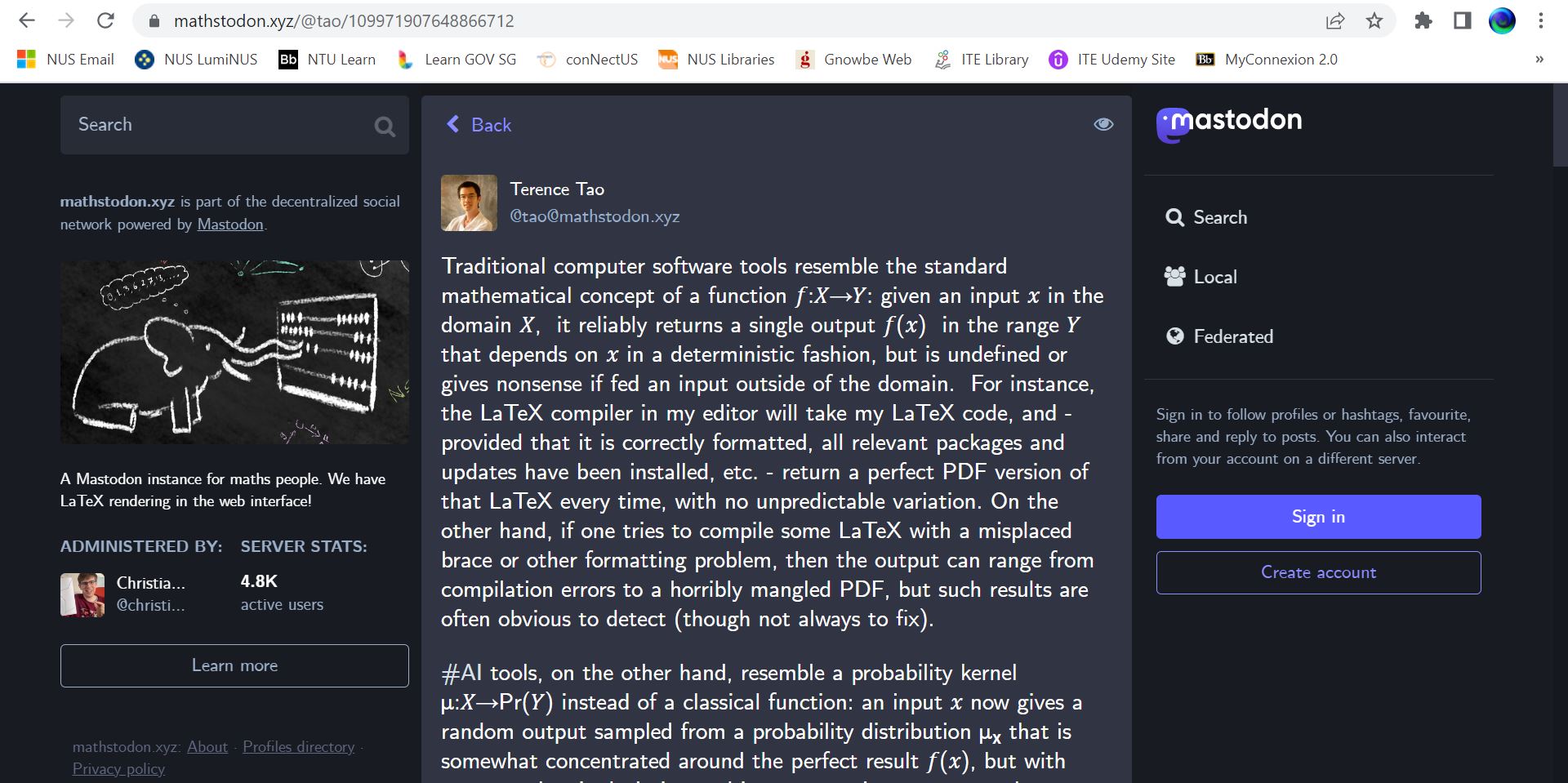

Terence Tao, a professor of mathematics at the University of California, Los Angeles (UCLA), and winner of the Fields Medal in 2006 posted a sharing reflecting on traditional computer software tools vs. artificial intelligence (A.I.) powered software features.
His reflection focused on large language models (LLMs) AI that are all the rage at this moment in time. Going down to the Logic and Math, he explained how traditional software heuristics (translated from human design) is guided by our intent, perception and problem-solving of the world, while LLMs utilise probabilistic way of problem-solving.
Basically, the LLMs solve problems by the equivalent of someone rolling the dice to get the answer to a question. The difference is the state of compute in modern era allows for the computer to roll the dice more accurately to hit on answers whose patterns appear more frequently in its learning data set. Where the dataset contains a lot of parameters for combination purposes, it may appear to the human who is not aware of what goes on in the black box, that the AI feature is “smart” enough to provide a novel answer.
The AI LLMs unfortunately do not actually “understand” from its old learning to solve new problems. This means that the incorporation of AI empowered features into software design have to fit whatever it is intended to solve. Otherwise the software might be marketed in a very misleading way.
The link to Terence Tao’s sharing on Mathstodon.xyz can be found here. Ref: https://mathstodon.xyz/@tao/109971907648866712
Some resource on Logic and Math from Stanford University can be found here:
- Stanford University. Online. Courses. Introduction to Mathematical Thinking. Ref: https://online.stanford.edu/courses/hstar-y0001-introduction-mathematical-thinking
- Stanford University. Stanford Introduction to Logic. Ref: http://logic.stanford.edu/intrologic/homepage/index.html